
You’ve been meaning to renovate for two years. But the thought of living through it — the dust, the noise, the workers in your space, the bathroom out of action for weeks — keeps pushing it down the list. So it never happens. The renovation stays on the list. The list stays on the shelf.
Here’s the thing: your next trip back home is the best window you’ll get. While you’re away, the condo sits empty anyway. There’s no one to disturb, no daily life to work around, no bathroom you need mid-renovation. The work that would have been an ordeal if you were living through it becomes something that simply happens while you’re elsewhere.
Done properly, a renovation timed around a home visit can be finished — or nearly finished — by the time you’re back, with you having seen and approved every detail before you left.
Here’s how to make that work.

Why an Empty Condo Is the Right Time
A renovation in an occupied home is a disruption. You’re navigating around tools and materials, putting up with noise during the day, losing the use of a room — or the whole unit — for the duration. For a bathroom or a full interior job, that can mean weeks of living on a building site.
When you’re away, none of that matters. The condo is empty. The work can run at full pace without anyone’s daily life to accommodate. You come back to a finished space instead of enduring the process to get there.
That’s the opportunity. The challenge is the flip side of the same coin: you won’t be there while it happens. And a renovation you can’t see while it’s underway is exactly where things go wrong in Pattaya — unless it’s set up the right way from the start.
The rest comes down to two things: getting everything decided and documented before you leave, and choosing a contractor who can be trusted to build to that standard while you’re not watching.
Everything Has to Be Decided Before You Leave
This is where most owners get it wrong. They think they can sort out the details remotely once they’ve gone — approve things over LINE as they come up, make decisions from abroad. In practice, this is how renovations drift. Every unanswered question becomes a delay. Every decision made at a distance, without seeing the space, is a decision made on incomplete information.
The window when you’re physically present — before you fly out — is the only time you can finalise everything in person. Use it. By the time you board the plane, the following should already be complete:
- Design finalised and approved
- Scope of work documented in writing
- Materials and finishes selected
- Quotation reviewed, signed, and deposit paid
- Start date confirmed
You can look at a tile sample under the actual lighting in your unit. You can sit across from the project manager, ask a direct question, and watch their face when they answer. You can walk the space and point at exactly what you want. None of that is possible once you’re gone — so do it while you can.
If a contractor cannot provide you with a full written specification — covering every finish, every material, every item of scope — before you leave, that is not a contractor who can be trusted to build to a standard while you’re not watching. The inability to document the job beforehand is a reliable sign of how the job will be managed throughout.
Get every decision on paper. Not as a general description. As a specific, itemised record: which tile, which size, which grout, which fixture, which brand. Vague agreements produce vague results — and you won’t be there to catch them.

While You’re Away: Remote Oversight Is Everything
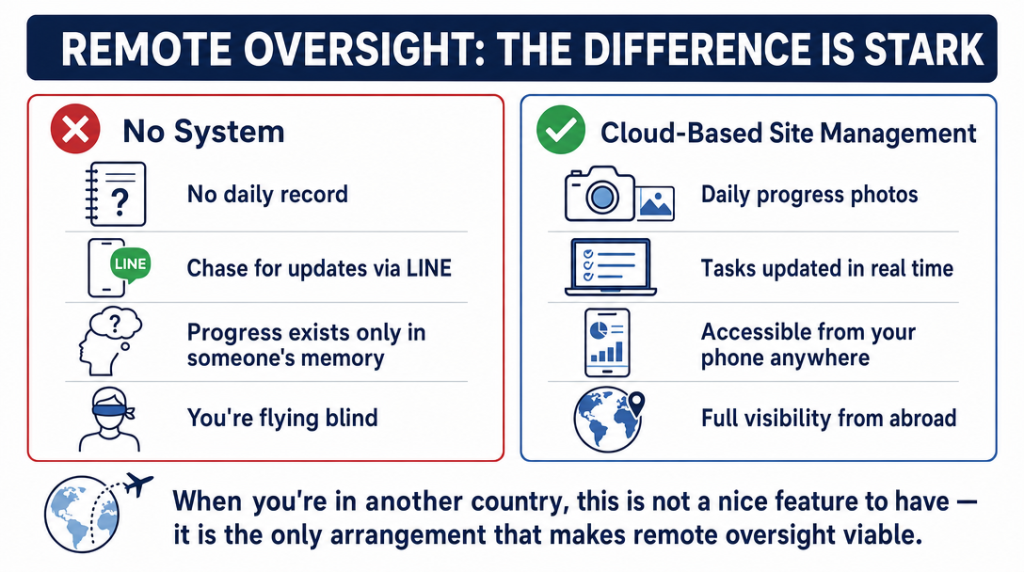
Once you’ve left, you can no longer walk the site. You can’t verify what happened on a given day with your own eyes. This is the highest-risk phase of the whole project — you’re in another country, and the work carries on without you. How that risk plays out depends almost entirely on one thing: whether you can actually see what’s happening.
This is where the difference between contractors becomes stark.
Most contractors in Pattaya do not use any kind of digital site management. There is no system, no shared record, no way to see what happened on a given day unless someone physically goes to the unit. If you message and ask for an update, the honest answer is often “I’d have to go and check.” Progress exists only in the project manager’s head, and communication happens whenever someone remembers to send a message. When you’re sitting in another country, that’s not oversight — it’s hope.
A contractor who manages sites with a cloud-based system is a different experience entirely. Progress photos, completed tasks, and site conditions are updated daily and accessible from anywhere — from your phone, in another time zone, at any hour. You don’t need to be on site to know what’s happening. You don’t need to chase for information. The record exists independent of anyone’s memory, and it’s available to you in real time.
When you’re managing a renovation from abroad, this is not a nice feature to have. It is the only arrangement that makes remote oversight viable.
Coming Back: The Handover Has to Be Built on Paper
Here is where a renovation run while you’re away most commonly falls apart at the final stage.
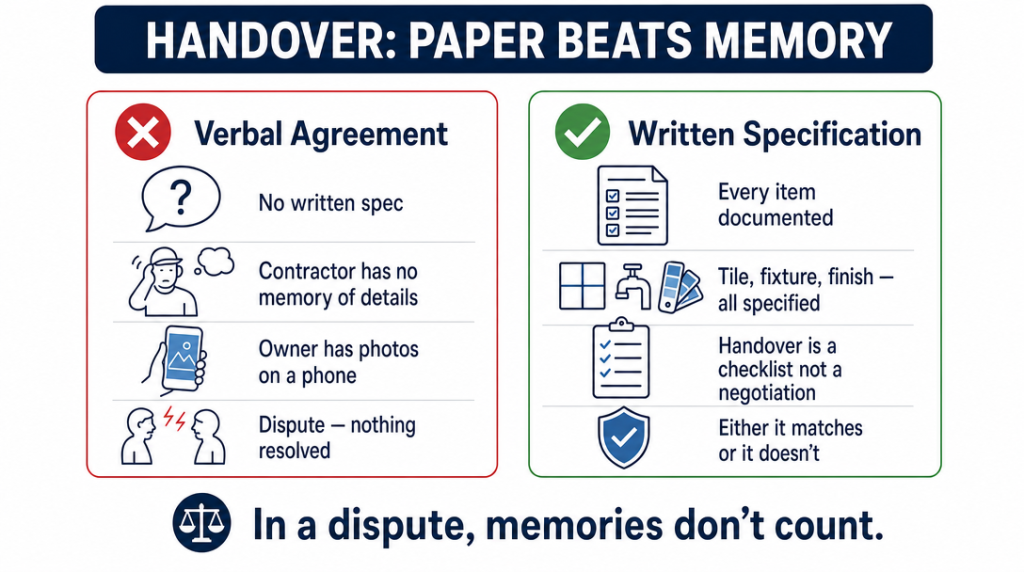
You’re back home, the work continues, weeks pass. Eventually, the contractor says it’s done. You return to Pattaya — or ask for photos before you fly back — and discover that something is wrong. A finish doesn’t match what was agreed. A fitting is different from what you selected. A detail was skipped.
The dispute that follows almost always ends the same way: nothing is resolved. The contractor has no memory of the specific agreement. The owner has photos on their phone and a recollection of a conversation. Neither is proof of anything.
The only protection against this outcome is a written specification produced before work begins — one that is specific enough to compare against the finished job, line by line. If every item in the scope was documented — the exact tile, the exact fixture, the exact finish — then handover is not a negotiation. It is a checklist. Either the item matches the specification or it doesn’t. The record settles the question before it becomes an argument.
Verbal agreements, approximate descriptions, and photos taken during a contractor meeting are not documentation. They are memories. In a dispute, memories don’t count.
Ask for the specification in writing before you commit to anything. If the contractor cannot or will not produce one, you already have your answer.
A Realistic Timeline
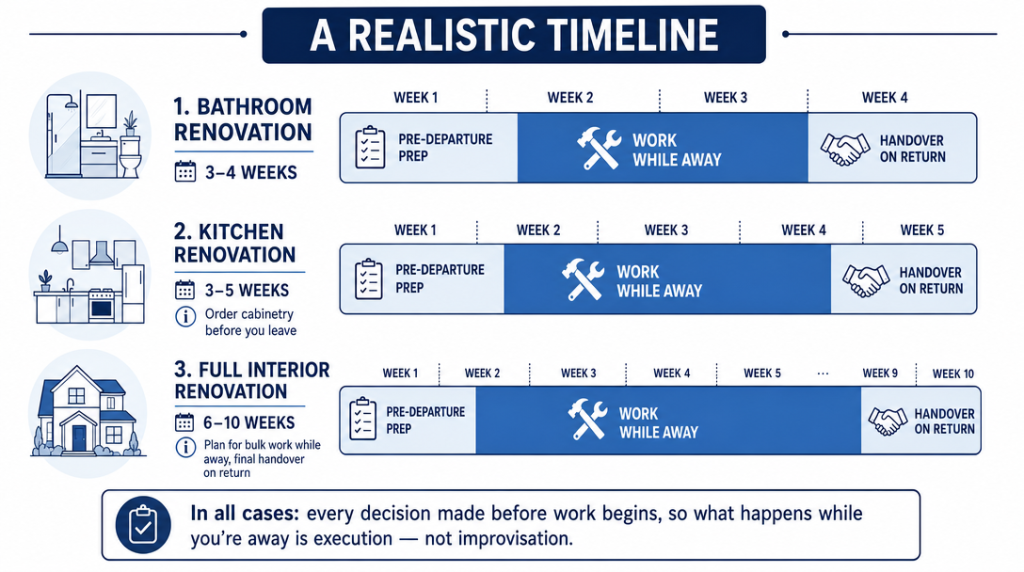
How much can actually be completed while you’re away depends on the scope of the work and the length of your trip:
Bathroom renovation (standard size): 3–4 weeks from start to handover. A trip of around a month means the work can begin shortly after you leave and be finished — or close to it — by the time you’re back.
Kitchen renovation: 3–5 weeks depending on scope and cabinetry lead times. Confirm the cabinetry order before you leave so the lead time runs while you’re away, not after you’re back.
Full interior renovation: 6–10 weeks or more. This will likely run longer than a single trip. Plan for the bulk of the work to happen while you’re away, managed remotely with daily updates, with final handover when you return.
In all cases, the goal is the same: every decision made and documented before work begins, so that what happens while you’re away is execution — not improvisation.
What This Means for You
If you’ve been putting off a renovation because you don’t want to live through it, your next trip home solves that problem. The disruption happens while you’re not there. You come back to the finished result.
But it only works if the groundwork is done before you go. The owners who get renovations done well while they’re away are not the ones with the longest trips. They’re the ones who left with everything already decided. The contractor knew exactly what to build. The documentation existed before the first tile was moved. And throughout the work, they could see daily progress from their phone, wherever they were.
That level of confidence requires a contractor who works in writing as a matter of course — not one who will produce documentation when pressed — and a site management system that gives you real visibility, not just occasional reassurance.
If you’ve got a trip home coming up and a renovation you’ve been meaning to do, the time to start that conversation is now — well before you leave.

One More Thing — A Free Resource
We’ve put together a full guide called “Why Most Pattaya Renovations Go Wrong” — a detailed read that goes deeper into how this market actually works, the most common failure points, and how to spot a contractor who’ll see the job through properly.
We’re offering it free to anyone who contacts us for a quotation.
Get in touch, we’ll arrange a free site visit and written proposal — and send the guide along with it, no strings attached.
Thinking about a renovation? Request a free quotation via WhatsApp or LINE.